.png)
You’ve built a great company. Your product is technically sound, your team is strong, and your offering beats the competition on specs. So, why are your sales cycles long? Why are you spending more to acquire fewer customers?
The answer lies in a flawed market understanding. Most business leaders mistakenly believe that a superior product guarantees market success. This is the Better Mousetrap trap. Customers do not purchase your features; they hire your solution to make progress in their lives.
This fundamental concept defines the Jobs to be Done (JTBD) framework. JTBD is not a marketing theory; it is a discipline of causal logic that identifies the precise circumstances and motivations compelling a customer to choose your solution over an alternative.
Stop asking, "Who is our customer?" Start asking, "What is the urgent, unsolved struggle?"
TLDR;
Founders struggle with slow growth and rising acquisition costs because they focus on selling features instead of selling the progress customers want to make. Jobs to be Done reframes everything by asking one question: What struggle is the customer trying to solve right now?
People do not buy tools. They buy outcomes, confidence, clarity, and momentum. Once you understand the real job behind the purchase, you move away from demographics and long feature lists and start building your message around the progress customers want.
JTBD helps you:
• Identify the moments that push buyers to act
• Diagnose the fears that stop them from switching
• Replace wasteful feature marketing with outcome messaging
• Align sales, product, and onboarding around customer progress
• Reduce CAC and strengthen competitive advantage
In this blog we break down the real value of your service/product, the JTBD framework, and how you can start doing it today.
Why Founders With Great Products Still Struggle to Grow Revenue and Shorten Sales Cycles
Founders are inherently obsessed with their creations. This focus, while driving innovation, becomes a strategic weakness when it dictates market strategy. You spend capital shouting about functionality, convinced that if the market just understood your technical advantages, they would convert.
This approach creates a significant financial burden. It drives R&D waste, fuels endless feature creep, and results in poor customer retention. You have meticulously engineered a powerful drill, yet your customer only needs a quarter-inch hole.
The Features vs Progress Dilemma
This operational blindness is expensive. Recent Canadian economic analysis suggests that companies relying purely on feature-based marketing saw their Customer Acquisition Cost (CAC) increase by nearly 20% between 2024 and 2025 as the market became saturated with lookalike products. You are spending more money to acquire customers, only to watch them leave because you failed to address their core motivation. This data is critical for understanding market dynamics.
The JTBD Solution forces you to detach your ego from the product. You realize that the product is merely a vehicle. Your core value lies in the emotional, functional, and social progress your solution enables. Adopting JTBD is fundamentally an act of capital efficiency and customer centricity.

How Identifying the True Buying Triggers Can Make Customers Finally Choose Your Solution
Defining your market by attributes like age, income, or industry is strategically insufficient. These demographics provide correlation, but they never explain the causation behind a purchase. True market definition lies in identifying a shared, high-stakes struggle that demands a solution.
Your addressable market isn't "mid-sized financial firms." It is "Financial managers anxious about maintaining regulatory compliance without hiring three new staff members."
The secret to an effective marketing strategy that leads to sales is the combination of defining your market attributes and the why behind the buy. This is your brands positioning and why it's is so crucial to take the time to properly focus these efforts at the beginning.
The functional, emotional, and social outcomes customers are actually trying to achieve when they buy
The Job to be Done is complex. It serves as the bedrock for your strategic positioning, product roadmap, and organizational alignment. It must be analyzed across three critical dimensions:
The Functional Job: The tangible, practical task the customer needs to accomplish.
The Emotional Job: The subjective, personal state the customer seeks.
The Social Job: How the customer wants to be perceived by their peers, boss, or community.
When you understand these three areas, you grasp the total value proposition. You stop building generic features and start engineering specific, high-value progress.
The Common Marketing Mistakes That Cause Overspending and Fewer Conversions
Traditional marketing methodologies create expensive strategic blind spots that divert R&D resources and fail to capture high-value customers. You must assess the true cost of these five pitfalls:
1.) Why demographic-based marketing alone does not drive conversions for growing businesses
Marketing based solely on age or location delivers ineffective, broad messages. You target a large, undifferentiated audience, resulting in high advertising spend and low conversion rates. You are missing the true purchasing signal, which is always rooted in a specific context.
2.) How feature-heavy marketing hurts customer understanding and increase R&D waste
Your marketing lists specifications like "20 integration connectors" instead of value like "Seamlessly consolidate all your legacy data in 48 hours." This failure to translate features into outcomes allows R&D teams to indulge in feature creep. They build features they can, not features that solve an urgent Job.
3.) Most CEOs are overlooking these competitors when analyzing their market
Your competition is not just direct rivals. If your customers are struggling to manage data, your chief competitor might not be another software firm, but the manual workflow they use today.
4.) Buyer anxieties are stopping customers from switching to a new solution even when they see the benefits
You promote the upside without addressing the fear of change. If your materials do not actively de-risk the transition, customers default to the painful but familiar status quo.
5.) Generic messaging is weakening conversion rates and confusing your audience
Creating a generic message to capture the "average" customer guarantees you resonate with no one. When you chase the middle, you dilute your value proposition and weaken sales effectiveness.
How companies can design a customer journey that makes switching to their solution feel safe and obvious
JTBD provides a precise roadmap for overcoming these strategic failures. It flips the sales conversation from what your product is to what your customer becomes after using it. This means going from selling a drill to selling the hole that the drill creates.
The psychological forces that determine whether a customer adopts a new solution or stays with the current situation
Growth requires movement. Customers only switch when the total force pushing them toward a new solution outweighs the forces holding them back. JTBD identifies four forces: Push, Pull, Anxiety, and Habit.
Great marketing lowers Anxiety (guarantees, social proof, easy onboarding) rather than just increasing Pull. You explicitly map out the customer's resistance to purchase, allowing your sales team to anticipate and neutralize objections before they become deal breakers.
.png)
"Selling is understanding what progress people want to make, and what they are willing to pay to make that progress. Our product or services are merely part of their solution. You create pull for your product because you are focused on helping the customer." — Bob Moesta, JTBD Practitioner.
How to integrate the JTBD framework into operations to align marketing, sales, and product
To turn interest into action, JTBD must move beyond marketing and influence every department. This requires a disciplined, repeatable process. In its entirety the process looks like this:
Step 1.) Conduct the Switch Interview
Most customer feedback surveys are useless for marketing strategy. Asking "On a scale of 1-10, how much do you like our dashboard?" tells you how they are using the product, but it doesn't tell you why they bought it in the first place.
To uncover the Job to be Done, you need to conduct a Switch Interview. The goal of this interview is not to talk about your product features. It is to film a mental documentary of the customer's life, specifically focusing on the timeline leading up to the purchase. You are looking for the "domino" events that pushed them from "I'm fine" to "I need to change this."
This is the only data that matters. You must talk to customers who have recently bought your product. Do not ask, "What do you want?" Ask, "What happened on the day you decided to look for a solution?" Identify the trigger event.
- The Trigger: "What happened on the specific day you finally decided to pay for a solution? Was there a 'straw that broke the camel's back'?"
- The Anxiety: "Before you clicked 'buy,' was there anything that made you hesitate? What were you worried might happen?"
- The Outcome: "Now that you have the product, what is the one thing you can do now that you couldn't do before?"
This research informs your entire organization. Sales uses it for discovery. Product uses it for feature prioritization. Customer Success uses it to define the onboarding path to progress.
The Questions You Should Be Asking in Switch Interviews to uncover why customers decided to buy
You are a detective building a timeline. Use these questions to uncover the struggle:
1. "Take me back to the very first time you thought, 'I need to solve this problem.' What were you doing at that exact moment?"
- The Goal: This identifies the First Thought. It helps you understand the context (time of day, location, specific frustration) where the seed was planted.
2. "You didn't buy immediately after that first thought. What were you doing to get by in the meantime?"
- The Goal: This reveals the Passive Looking phase and your true competition. Were they using a spreadsheet? Asking a friend? Ignoring the problem? This is the "old way" you need to market against.
3. "What happened on the specific day you finally decided to pay for a solution? Was there a 'straw that broke the camel's back'?"
- The Goal: This identifies the Trigger Event. Usually, a purchase isn't a gradual decision; it’s a snap decision caused by a specific bad experience. Example: "I lost the client's file again and looked like an idiot in the meeting."
4. "What other solutions did you look at, and why did you reject them?"
- The Goal: This highlights the Push and Pull forces relative to competitors. It tells you exactly what your market dislikes about the current alternatives.
5. "Did you talk to anyone about this decision before you bought? Who were they?"
- The Goal: This uncovers the Social Job. Are they trying to impress a boss? Appease a spouse? Join a specific tribe?
6. "Before you clicked 'buy,' was there anything that made you hesitate? What were you worried might happen?"
- The Goal: This exposes the Anxiety force. If you know their specific fears (e.g., "It looks too complicated to set up"), you can write marketing copy that directly alleviates that fear (e.g., "Set up in 5 minutes, no code required").
7. "Now that you have the product, what is the one thing you can do now that you couldn't do before?"
- The Goal: This gives you your headline. This is the Desired Outcome and the "New Me."
JTBD Interview Tips
- Act like a documentary filmmaker: If they say, "I was frustrated," ask, "What time of day was it? Who was in the room? What was the weather like?" Specifics trigger memory and reveal context.
- Ignore the product: If they start talking about features ("I like the blue button"), gently steer them back to the story ("That's great, but let's go back to before you bought it...").
Step 2: Job Map Creation and Strategy Formation
Use the interview results to fill in this framework. This statement becomes your north star for all marketing copy. To learn more on the entire job map creation stage you can visit A Comprehensive Guide - Strategyn
For this blog we are just hitting the surface to create a Job Statement: "When I am [Context], I want to [Motivation/Action], so that I can ." to improve your marketing.
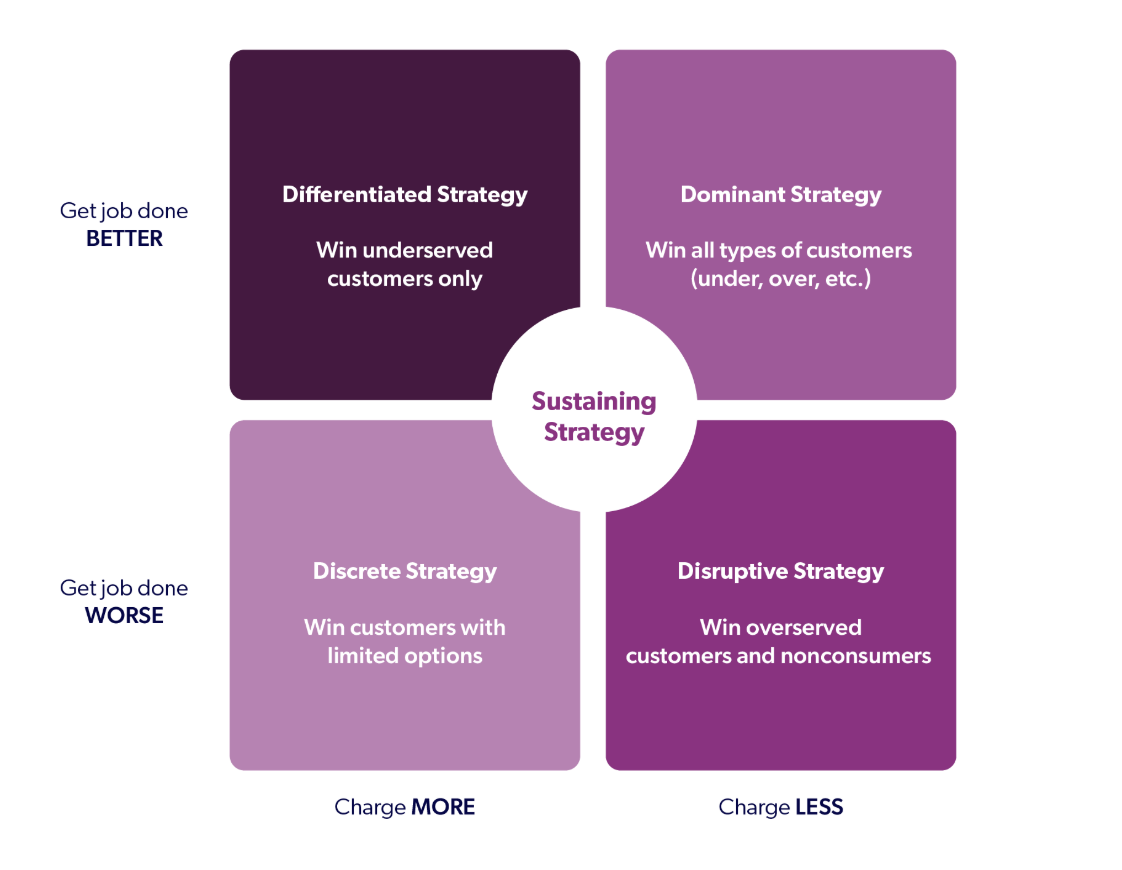
The different JTBD strategies:
- Differentiated Strategy - Offer a better service at a higher price
- Dominant Strategy - Be both better and cheaper
- Disruptive Strategy - Become simpler and cheaper to meet basic needs.
- Discrete Strategy - You offer a very specific service and customer shave limited options
- Sustaining Strategy - Make small improvements to your existing products
Step 3.) Review Your Marketing and Advertising for JTBD
At this stage you're ready to review and implement JTBD into your marketing and advertising and test the outcome.
Focusing Your Copy: Selling the Outcome, Not the Tool
The biggest mistake marketers make is using generic language (e.g., "fast," "easy," "affordable"). JTBD forces you to replace these adjectives with verbs and outcomes that directly reflect the Job Statement you developed.
- Audit Your Headlines: Look at the main headings on your website, landing pages, and ad creatives. Do they mention the name of your product, or do they immediately address the customer's struggle?
- Before (Feature Focus): Acme Corp: The Best Project Management Software.
- After (Progress Focus): Stop Wasting 10 Hours a Week Chasing Updates. Finish Your Week on Time.
- Translate Features into Progress: Every feature must be tied back to its functional, emotional, or social job. Customers don't buy 10GB of cloud storage; they hire the ability to "Save 5,000 photos without worrying about monthly fees" (Functional Job) so they can "feel secure about their memories" (Emotional Job).
- Precision Messaging: Use the exact language customers used in your Switch Interviews. If they consistently called their current spreadsheet system "the monthly monster," use that phrase in your ads. This creates instant recognition and trust.
Designing Campaigns Around the "Switch"
Effective JTBD advertising campaigns target the Four Forces of Progress (Push, Pull, Habit, and Anxiety), directly accelerating the customer's decision to switch.
- Amplify the Push (Pain): Your ads should demonstrate profound empathy for the customer's current struggle. Start the campaign by illustrating the pain point and the high cost of not switching.
- Example: A campaign might show a founder missing their child's soccer game because they are stuck doing manual reporting. This amplifies the emotional cost of the old solution.
- Highlight the Pull (New Outcome): Use visuals and testimonials to show the "New Me" the customer becomes after adopting your solution. Focus less on how the product works and more on what life looks looks like when the job is finally done well.
- Address the Anxiety (Risk): Switch anxiety is a major conversion killer. Your advertising must actively reduce this fear.
- Tactics: Offer robust money-back guarantees, clear (and fast) onboarding timelines, and social proof that directly speaks to ease of use. "Our implementation takes just 48 hours guaranteed."
- Counter the Habit (Inertia): Show how easy it is to migrate or integrate your solution with their existing tools. Positioning your product as a seamless upgrade rather than a disruptive overhaul removes a significant barrier to action.
JTBD In Action: The McDonald's Milkshake Case Study
To show you how powerful this thinking is, let's look at the famous case study where the Jobs to be Done theory was applied to a simple product: the McDonald’s milkshake.
The Traditional Approach (The Flop)
McDonald's wanted to increase milkshake sales and used traditional marketing research to:
- They segmented customers by demographics (age, income, etc.).
- They conducted focus groups and asked customers: "How can we make this milkshake better? Do you want it chunkier, sweeter, or cheaper?"
Based on this direct feedback, they improved the product. Sales did not budge. The company was trying to sell a better product without understanding the underlying reason it was being bought which is the core of successful marketing.
The JTBD Investigation (The Discovery)
The company brought in researchers who ignored the focus group data and instead adopted the "Switch Interview" and observational approach. They spent a full day simply watching:
- Who bought the milkshakes?
- What time did they buy them?
- What else did they buy?
- Did they drink it there or take it to go?
The pattern was striking: Nearly 40% of all milkshakes were sold before 8:30 AM. They were purchased by solitary commuters, who bought only the milkshake and immediately drove off.
The True Job to Be Done
When the researchers interviewed these early-morning buyers, they found the milkshake was hired to do a complex job with three dimensions:
The milkshake was the perfect solution: It was tidy (unlike a bagel), it lasted 23 minutes (unlike a banana), and it gave the user a small, guilt-free treat to do with their free hand.
The Marketing and Product Outcome
By understanding the Job to be Done, the necessary improvements became obvious, and the marketing message wrote itself:
- Product Improvement: They made the milkshake thicker and added small chunks of strawberries not for flavor, but to make it last longer and provide intermittent novelty to occupy the driver during the long commute.
- Service Improvement: They moved the milkshake dispensing machine to the front of the counter and offered pre-paid swipe cards to streamline the morning drive-thru experience (addressing the Anxiety of being late for work).
- Messaging Shift: The marketing stopped shouting about flavor and started speaking to the struggle (e.g., "Make Your Morning Commute the Best Part of Your Day").
This shift unlocked immense growth, proving that the job is a far more powerful unit of analysis than the customer.
The video Clay Christensen: The Jobs to be Done Theory provides further insight into the rationale behind the Jobs to be Done framework, which is perfectly illustrated by the milkshake story.
Conclusion – Stop Selling Products and Start Selling Progress
Customers are not choosing between products. They are choosing between staying stuck and finally making progress.
Features alone cannot deliver that change. JTBD reveals the real triggers behind a purchase. It shows you what pushed someone to search for a solution, what made them hesitate, what alternatives they considered, and what progress they hoped to achieve. When you use this understanding to guide your marketing, sales conversations, and product priorities, you move away from guessing and start designing your entire business around what the customer is trying to accomplish.
This creates faster sales cycles, stronger retention, and a message that resonates. JTBD is not a branding tactic. It is a strategic shift. The companies that act on this will capture the next wave of growth. The ones that ignore it will continue spending more to promote value the customer was never seeking.
If you want your product to drive revenue instead of simply existing in the market, start with the job your customer is hiring you to do and build every decision around that progress.
Grow your business
Take the first step with a discovery call – no pressure, just strategy.